MALIKA ZARRA
FRI, NOV 6, 2026, 8 PM at LEFRAK CONCERT HALL
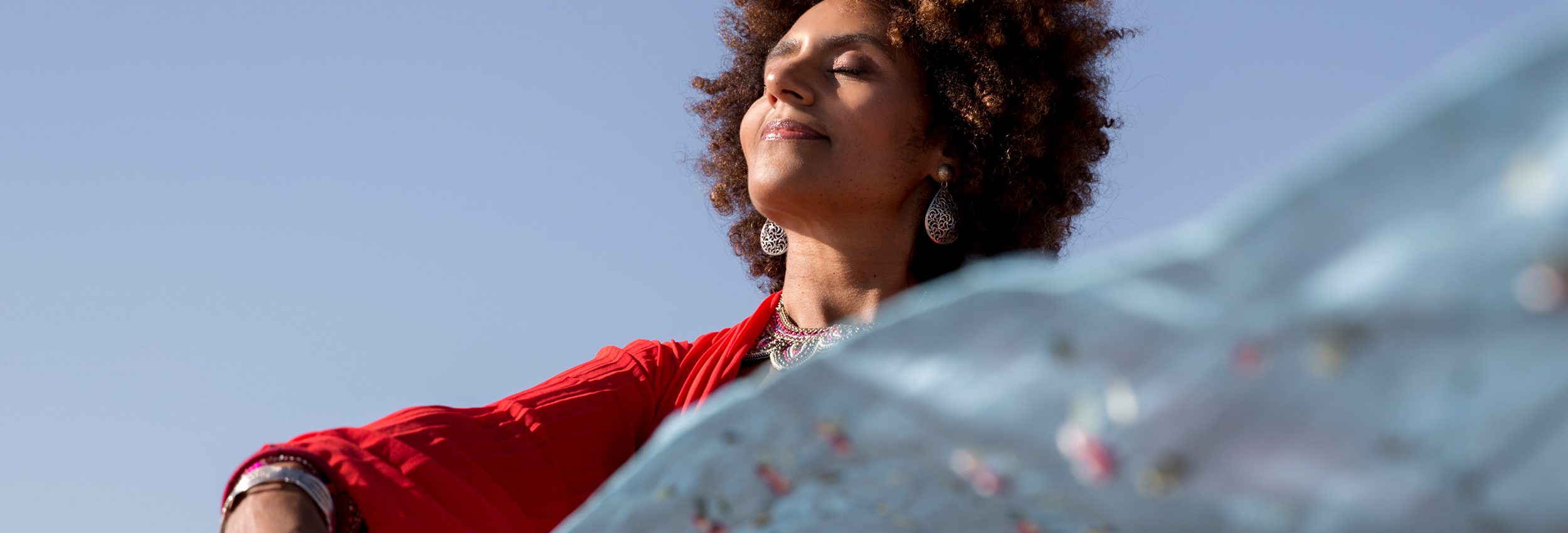
Jazz, rooted in African and diasporic traditions, is defined by its spirit of improvisation—and few embody this more than Malika Zarra. A Moroccan-born, French-raised, and globally celebrated singer, composer, and producer, Zarra fuses North African chaâbi, Amazigh (Berber), and Gnawa rhythms with contemporary urban jazz. Singing in Amazigh, Arabic, French, and English, her velvety mezzo-soprano and multicultural sound have captivated audiences worldwide, making her a powerful voice in the global jazz scene.
Malika Zarra – vocals & percussion
Jean-Christophe Maillard – guitar, banjo & back vocals
Mamadou Ba – bass
Yayo Serka – drums
Nizar Dahmani – percussion
Special Guest: Grégoire Maret – harmonica
SET LIST
- Feen
- All the same
- Leela
- Ouhelt
- Loukt
- La!
- Zrigh
- Mamalia
Program subject to change
MORE ABOUT THE ARTIST
Jazz has been called one of America’s greatest contributions to the world’s culture, but it’s important to remember it’s an art form that has grown from countless cultural exchanges with artists and styles outside the U.S. An inspiring new international voice, who is both influenced by jazz and is bringing her own culture and creativity to the melting pot, is MALIKA ZARRA. Born and lived in Morocco, raised in France, and now living in New York City, this gifted composer, producer and singer has invented a new Moroccan urban-world-jazz by tastefully using traditional North African chaâbi, Amazigh (Berber) and Gnawa polyrhythms to underpin her distinctly contemporary urban compositions, all the while maintaining a sophisticated improvisational modern jazz approach.
Award-winning singer/composer/producer, MALIKA ZARRA is a multi-cultural shape-shifter, an enchantress who leaps effortlessly between seemingly unconnected languages and traditions, uniting them while utilizing each to further enrich the others. The exotically beautiful artist with the velvety, sinuous mezzo-soprano voice has demonstrated a rare ability to communicate both powerful and subtle ideas and feelings in Amazigh (Berber), Moroccan Arabic, French and English, now a much-in-demand headliner at concert halls and festivals the world over.
Malika was born in Southern Morocco, in a little village called Ouled Teima. Her father’s family was originally from Tata, a city on the Sahara plain, while her mother was a Berber from the High Atlas. During her early childhood, there was always music and dancing in the house. After her family emigrated to a suburb of Paris, she found herself straddling two very different societies. “I had to be French at school yet retain my Moroccan cultural heritage at home,” she recalls. “Like many immigrant children, I learned to switch quickly between the two. It was hard but brought me a lot of good things too.”
Malika’s interest in music led her to take up the clarinet in grade school. Meanwhile, she was being exposed to a wide variety of musical styles; she cites fellow Moroccan Hajja Hamdaouia, Rais Mohand, the Lebanese-born, Egyptian-based ud virtuoso/composer Farid el Atrache, Um Kalthoum and Algerian singer Warda (Al-Jazairia) as major influences. She also absorbed albums by Ella Fitzgerald, Bobby McFerrin, Thelonious Monk, Stevie Wonder and Aretha Franklin. “When I decided to learn singing, I started with jazz because I was attracted by the improvisation, which is also important in Arabic music,” she says. Although her family was not in favor of her pursuing a musical career, Malika nonetheless attended classes at conservatories and jazz academies at Tours and Marseille.
An early visit to New York made a strong impression on her. “I came the first time in 1996. It was an amazing experience. I felt that I could be more myself and learn a lot of things, musically and as a human being.” In 2004, Malika decided to relocate to New York City. Having crafted a repertoire that incorporated her native Berber (Amazigh), Gnawa (a percussive form of religious trance music) and Chaabi (Arabic working class blues) heritages, the intellectual elegance of French pop, plus freewheeling jazz rhythms and techniques, her reputation as a solo act began to grow.
Malika eventually recorded and/or performed with John Zorn, Arturo O’Farrill & The Afro Latin Jazz Orchestra, Aruan Ortiz, Tommy Campbell (Dizzy Gillespie), Will Calhoun (Living Colour), Lonnie Plaxico (Cassandra Wilson), Michael Cain (Jack DeJohnette), Brad Jones (Ornette Coleman), Jacques Schwarz-Bart (Roy Hargrove), Gretchen Parlato, Yazz Ahmed and many others.
Among the venues she has graced are Carnegie Hall (opening for Bobby McFerrin) (NYC), the Opera House at Lincoln Center (NYC), the Apollo Theater (NYC), the London Jazz Festival (UK), the Montreal Jazz Festival (Canada), the International Black Arts Festival (Senegal), Teatro Colsubsidio Bogota (Colombia), Teatro Ateneo (Panama), the Chicago World Music Festival, the Festival du Monde Arabe Montreal (Canada), the Salzburg Jazz Festival (Austria), the Festival Nuits d’Afrique Montreal (Canada), Toronto Festival (Canada), the Blue Note Jazz Festival, Arab American National Museum (USA), the Banlieues Bleues Festival (France), WDR Funkhaus Cologne (Germany), Vienna Konzerthaus (Austria), Wels Festival (Austria), Porgy & Bess Jazz Club Vienna (Austria), Timitar Festival (Morocco), the Duke Ellington Jazz Festival (DC), the Kennedy Center (DC), Brooklyn Maqam Festival (NYC), The Blue Note (NYC), The Jazz Standard (NYC), North Sea Jazz Club Amsterdam (Netherlands), Divadlo U Hasičů Prague (Czech Republic), Chorus Jazz Club, Lausanne (Switzerland), Africa Festival Wurzburg (Germany), Theatro Manzoni Milan (Italy), Klub Cankarjevega doma Ljubljana, Slovenia, Berlin Museum, Germany, Jazz Middelheim Festival (Brussels), Paper Museum Steyrermuhl (Austria), Hanover Jazz Club (Germany), Haltern am See (Germany), Munster Jazz Club (Germany), Domicil Jazz Club (Germany), Joe’s Pub (NYC), Sob’s (opening for Sara Tavares) (NYC), Smoke Jazz Club (NYC), Brooklyn Academy of Music (NYC), NYC Winter Jazzfest, Birdland Jazz Club (NYC), Outpost Performance Space (New Mexico), Baruch Performing Arts Center (NYC), Skirball Center for the Performing Arts (NYC), MET Museum (NYC), Philadelphia Museum of Art, Manhattan Center Grand Ballroom (NYC), Den Bosch-November Music (NL), Arnhem-Music & Stadstheater (NL), Amsterdam-Muziekgebouw (NL), Brussels-Flagey (BE), Antwerpen-De Roma (BE), Gent-De Bijloke (BE), Eindhoven-Muziekgebouw (NL).